
A safe and stable indoor climate for advanced lab research
Swegon delivered a solution with custom designed supply and extract air systems, along with integrated air and water systems, tailored to the building’s diverse spaces and modern HVAC strategy.
Indoor climate for one of Europe’s leading hubs in ageing research
The CECAD Research Centre on the campus of Cologne University Hospital is the central building of the Cologne Cluster of Excellence on Cellular Stress Responses in Aging‑Associated Diseases (CECAD). It is one of Europe’s largest hubs for ageing research, designed by gmp Architekten von Gerkan, Marg und Partner.
The seven‑storey building offers approximately 28,290 m² gross floor area and unites laboratories, offices, an auditorium and a publicly zone with cafeteria and entrance hall. The architectural ambition was to combine laboratory efficiency with an open, communicative atmosphere that supports interdisciplinary collaboration between researchers and clinicians.
A research environment designed for performance and well‑being
The client, Medfacilities GmbH, aimed to create a research environment that meets the highest scientific standards while remaining attractive, healthy and inspiring for an international research community. Central to the brief was the need for reliable indoor climate stability for sensitive experiments, together with flexible laboratory layouts that can adapt to evolving research programmes.
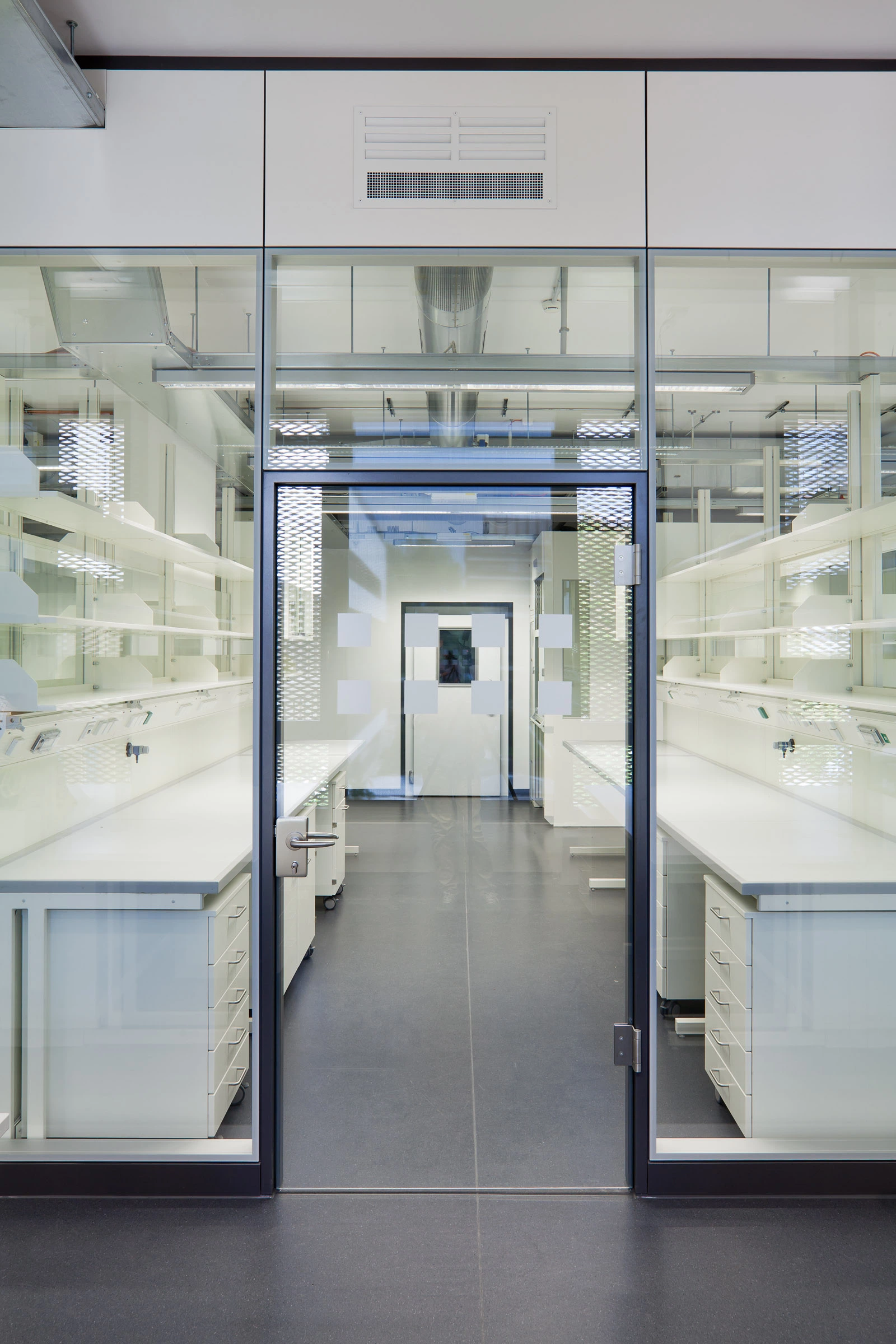
Controlled ventilation conditions were required for biological and chemical laboratories, alongside low background noise levels to support concentrated work in offices and meeting areas. At the same time, technical systems were expected to be carefully integrated so that air distribution supports, rather than dominates, the architectural design of façades and interiors.
Complex requirements across diverse building functions
Translating these ambitions into an effective air distribution solution required addressing several challenges in parallel. Laboratories with fume cupboards and instrumentation rooms present very different load profiles, all of which are served via shared shafts in a dense urban building structure.
In offices, meeting rooms and public areas, ceiling heights, beam structures and acoustic requirements limited the available space for ductwork and room units. The two‑story public base, cafeteria and auditorium each required individual airflow concepts, while every visible component had to meet the architectural standards of a flagship research building integrated into the existing hospital campus.
A coordinated air solution from a single supplier
Working closely with the planning office IGF Ingenieurgesellschaft Feldmeier and the executive companies Pleitz GmbH and Prinzing Gebäudetechnik GmbH, Swegon acted as a single supplier for the room‑side air distribution.
Over an extended development phase, ventilation components were specifically designed and dimensioned for the building’s mix of laboratory, office, public and special‑use areas. Rather than supplying isolated products, Swegon delivered a coordinated portfolio of supply, extract and air/water systems that function together as one consistent solution, fully aligned with the project’s architectural concept and modern HVAC strategy.
Tailored systems for labs, offices and public areas
The selected product mix reflects the diverse functional zones within the building. PDA, SKD and PU diffusers handle supply air in laboratories and offices with low sound power levels and high mixing efficiency. VZ‑41 slot diffusers and the combined VZ‑41‑ZA supply/extract units serve corridors, offices and façade zones with discreet, linear airflow patterns.
In laboratory areas, VZ‑AR tube diffuser systems, including the AKK‑TIE chilled‑beam, provide visible yet architecturally clean solutions with high cooling capacity.
Grilles and stainless‑steel design elements support extract air and architectural integration. KVR‑S constant flow controllers, VVSR-RU variable flow controllers and axial fan controllers ensure that air volumes and air pressure are maintained reliably throughout the building.
Read our blog about specialised HVAC solutionsStable lab conditions and energy‑efficient cooling for long‑term operation
The coordinated systems ensures stable laboratory air pressure, draught‑free supply air with low temperature differences and a low sound power level that supports focused scientific work. High internal loads from laboratory equipment and lighting are absorbed close to the source through induction‑supported tube diffusers and chilled beams, maintaining consistent room conditions over time. Architectural air terminals and design elements ensure that the ventilation system remains visually integrated.
The use of an air/water system based on chilled beams and tube diffusers allows water to be used as the primary medium for removing heating and cooling loads. Constant flow controllers and demand regulation help to reduce unnecessary energy usage and align air volumes with the actual use of each zone. In combination with the compact, well‑insulated building concept, the solution contributes to a research facility designed for long‑term operational efficiency.
Flexibility for changing research needs
During commissioning, each ventilation circuit was balanced and verified using Swegon flow‑rate measurement and adjustment components, providing clear reference values for future re‑commissioning.
The modular nature of the diffusers, controllers and chilled beams allows ventilation zones to be adapted, air volumes to be adjusted and components to be exchanged as research groups, equipment and protocols change. This flexibility is particularly relevant for a cluster of excellence whose research focus evolves through successive funding cycles.
A coherent indoor climate concept for advanced research
The CECAD Research Centre illustrates how a carefully coordinated solution can support both demanding scientific processes and ambitious architecture.
Swegon provided a solution that combines reliable laboratory ventilation, comfortable office and public environments and architecturally integrated visible components. The result is an indoor environment that supports the client’s vision of a sustainable, communicative and innovative research building - and that has played a key role in CECAD’s development as a leading European centre for ageing research.
