

Schools
Few environments shape the future as directly as schools, of course in terms of learning but also in regard to health. It is well established that the indoor climate has a clear impact on students’ well-being and their ability to learn and concentrate. It has an equal impact on teachers’ ability to be at their best. As most students spend a majority of their day in school during many years of education, it is vital to ensure a good indoor climate in this environment. This guide explains the most important considerations when designing indoor climate solutions for schools, with focus on health, energy efficiency and cost.
Schools are the same but different
Although schools may appear as similar from a macro perspective, presenting classrooms, corridors, auditorium and gymnasiums, there are notable differences between schools across countries, climates and cultures. The number of hours spent in school per day, and the number of school days per year, vary significantly and so does the ages and numbers of students in class.
School buildings may be old or new, located in the city centres, urban areas or on the countryside. All these factors, and many more, influence the requirements on indoor climate solutions in order to support concentration and productivity, health and well-being of both students and teachers.
Impacting indoor climate factors
Temperature, air quality and sound are often the most recognised indoor climate factors. They cannot be touched, but people often have a clear perception of what indoor temperature feels comfortable, what the air is like to breathe and which sounds are soothing or disturbing. Additional indoor climate factors are light, air velocity and humidity, which are generally more difficult to identify and describe, unless they reach extreme levels.
Behind these factors lies excessive research and there are now well-established theories and recommendations on what is acceptable levels and on how to ensure that these are balanced. Understanding these parameters and learning how to manage them, is the fundament for creating an optimal indoor climate.
Here are the indoor climate factors
Improve student health
Research show that ventilation, health and attendance correlate with each other. It is also true that improved classroom ventilation is linked to improved test results. With that as a fact, a good indoor climate with sufficient ventilation rates, reduces the risk of students and teachers coming down with headaches, asthma symptoms, respiratory problems and the like.
With less health issues that disturb and limit students’ and teachers’ time in class, attendance rates increase. However, it is not necessarily a correlation between increased attendance and test results, but it is proven that a good indoor climate helps test results as the good indoor climate supports alertness, memory and concentration.
Visit Swegon Air Academy for a deep dive in research
Why the indoor climate matters

Health, well-being and breathing the school air
Continuing the health and well-being perspective of the indoor climate in schools, it is important to recognise that children are not small adults. They are often too young to connect the dots between not being excited about school, an insufficient indoor climate and a general sense of not feeling well. The indoor climate cannot be seen or touched and is therefore difficult understand and explain.
It can be helpful to consider that human beings eat about 0,75 kg of food per day, drink about 1,5 litres of fluids and breath around 15 kg of air. If the air is not healthy, it is reasonable to assume that it may affect us negatively.
The air in schools is affected by various sources of pollutants including building materials and paints, textiles, plastics and electronics, and by people. Humans exhale carbon dioxide, and in a crowded classroom without ventilation, this can quickly affect both performance and well-being. Now, opening a window and letting pollen, exhaust emissionsm noise and else in, is not the way forward.
Find out more in our whitepaper
Mechanical ventilation is essential
In most schools, it is more common for a classroom to be empty than occupied. Research indicates that they are utlised as little as 30%. However, when in use, classrooms are often crowded which puts great demands on the indoor climate.
Unfortunately, many schools around the world rely on natural ventilation. That can make it difficult to meet ventilation demands at busy hours and it may affect thermal comfort, sound levels and air quality du to the outdoor conditions. Mechanical ventilation is essential, not only to supply enough fresh air and ensure a healthy indoor climate, but also to create a comfortable and productive learning environment.
The air handling unit and ventilation
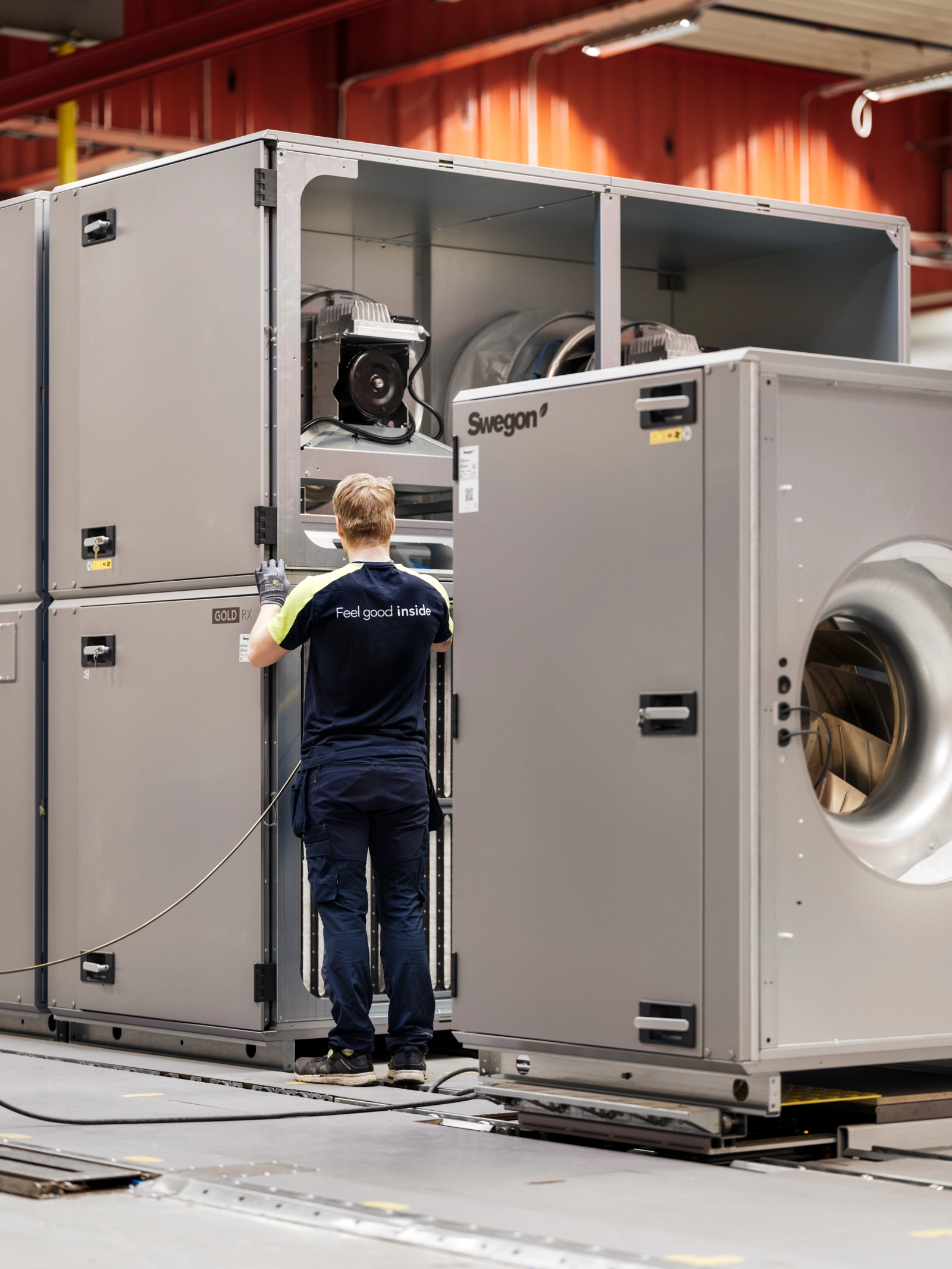
Questions can be raised regarding the good in mechanical ventilation, often referring to the value vs operational cost. To answer these, see the air handling unit as the heart of a good indoor climate. It is a complex unit that ensures the process of fresh air intake, conditioning and air supply into an indoor space, and it assures the extraction of used air from the same indoor environment. It is the alternative to opening windows and the means to an indoor environment that is not disturbed by the outside. It allows for an indoor climate that supports learning and give good opportunities for students to create value for themselves and others in the future.
A clear majority of AHUs today come with heat exchangers and the most advanced on the market can recuperate around 90% of the heating/cooling energy in the building. This is, for many reasons, a much better alternative than letting heated or cooled air out the window.
Guide: air handling units and ventilation
Further cost savings
The air handling unit is also a vital component in a system solution for demand controlled ventilation (DCV). A DCV system monitors the actual needs inside and lets the AHU adapt airflow, heating and cooling accordingly. This is highly efficient to meet the vast variations in occupancy that occurs in schools. In fact, many classrooms are not utilised more than 30% of the day. When using a DCV system, sufficient air quality is ensured when classrooms are used and crowded, and money is saved when classrooms are empty. This way of adjusting ventilation, heating and cooling is confirmed to bring energy savings of up to 80% of fan energy and 40% of heating and cooling energy.
Renovating
Approximately 75% of the European Union building stock is energy inefficient and schools are typically among the ones still relying on basic ventilation or opening windows. Today, there are several initiatives and regulations within the EU aimed to improve the energy performance of older buildings. The result is that many schools will face a need to renovate in order to align with these.
The entire spectrum of renovations is impossible to explain. However, there is a repeated recommendation worth knowing: despite a building being old, it may stand for many decades still. Therefore, renovate with flexibility and adjustability in mind, that way the indoor climate can meet today's needs inside and be adapted to the tomorrow's demands in the building.
Food for thought in our office guide
See our energy efficiency guide
5 recommendations
Even though each and every project needs to be considered from its own prerequisites and requirements there are a few things that we as experts can point out as essential factors when designing indoor climate solutions for schools.
These recommendations are shared with other applications which is why we have borrowed them to this guide and linked to its ordinary spot for more reading.

Product suggestions for a better indoor climate in schools
There are many ways to go about when designing indoor climate solutions for schools. However, one of the first decisions to make in schools, just like in almost any other building, is whether to opt for a centralised or decentralised solution.
In schools, a decentralised alternative can actually mean individually installed units in classrooms. Our COMPACT Air and CLASS UNIT are provided on a room-by-room basis and are not connected to central systems through ducting. This makes installation quick and disruption to classroom timetables minimal, while they operate extremely quiet because of their placement.
More about these units and the centralised alternative